“I’ll have to live all over what happened last year.”
“Cyrus Longworth is John Yaeger, and John Yaeger is Cyrus Longworth!”
The rest is silence.

“I’ll have to live all over what happened last year.”
“Cyrus Longworth is John Yaeger, and John Yaeger is Cyrus Longworth!”
The rest is silence.
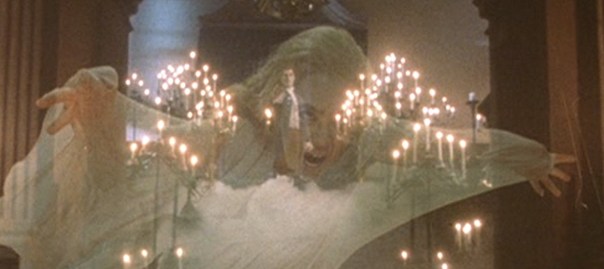
“It was some kind of mumbo-jumbo!”
Meanwhile, it’s 1790, and governess Victoria Winters is trapped by time, stuck two centuries early with no ride home. She’s been locked up and accused of terrible things, and now she’s on trial for her life, represented by pop-eyed barrister Peter Bradford. Opposing counsel is the Reverend Trask, who’s assisted by reckless spinster Abigail Collins and his own eyebrows, not necessarily in that order. And the Countess Natalie DuPres is terribly worried about her niece Josette, a young woman who seems entirely unable to date anyone with more than a couple of days to live.
Oh, and Barnabas — d’you remember Barnabas? He used to be the main character on this television show — Barnabas is in a box, all by himself.

“You know, I rather look forward to going to the future as Barnabas Collins.”
Some say the world will end in fire,
Some say in ice.
From what I’ve tasted of desire
I hold with those who favor fire.
But if it had to perish twice,
I think I know enough of hate
To say that for destruction ice
Is also great
And would suffice.
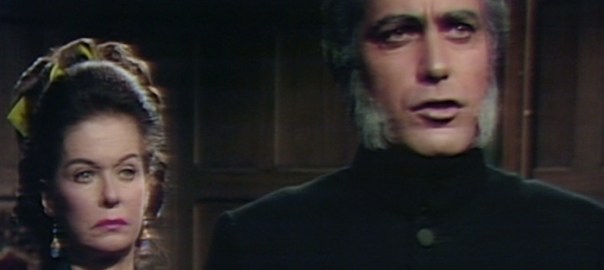
“But why should God be angry at Judith?”
Barnabas is staked, Quentin is swapped, Charity is possessed by a woman she hardly knows. As usual, the Collins family is full of supernatural ne’er-do-wells, who scream and scheme and stay up late, desperate to save each other from their latest fate worse than death.
Meanwhile, the grown-ups in the family go to work, and manage their investments, and take care of the property. They pay servants. They sign documents. They make decisions.
Some of those decisions are terrible, of course, especially in their choice of spouses, who tend to be monsters and murderers and reincarnations of people, but at least the grown-ups don’t dabble in the dark arts. Judith wouldn’t know a dark art if it came up and bit her, which, come to think of it, it actually did.
“If I only knew how you died, maybe I would know how to banish you!”
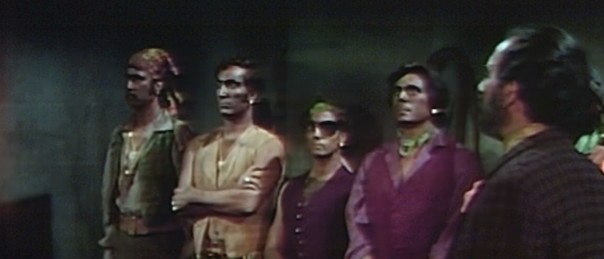
Order in the court! The honorable Johnny Romana — King of the Gypsies! — presiding.
In today’s episode, the accused, Magda Rakosi, stands before a jury of her peers, charged with the theft of the Legendary Hand of Count Petofi, and the murder of Julianka, a miniscule gypsy witch who came to fetch the Hand back.
Magda actually did steal the Hand, but she was only indirectly responsible for Julianka’s death, so I’d call this a draw. As a tiebreaker, I’d like to point out that Magda is a major character played by Grayson Hall, one of the all-time most interesting actors to look at, so there’s no way she’s going to be executed by a crew of day players and walk-ons.
Still, having a gypsy trial in the secret room of the mausoleum sounds like a blast, so I’ll allow it. Proceed.
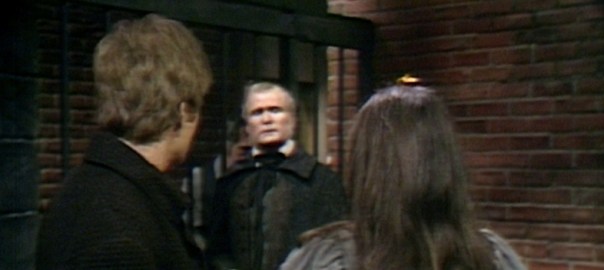
“I don’t believe any further explanation is necessary!”
Oh, great! More of this.
It’s been three weeks since we last saw time-traveling governess Victoria Winters, currently languishing in prison. Those were three good weeks. People seemed to laugh more, then. There were concerts in the park…
And now: Vicki and Peter. Pretty much nonstop for the next five episodes.
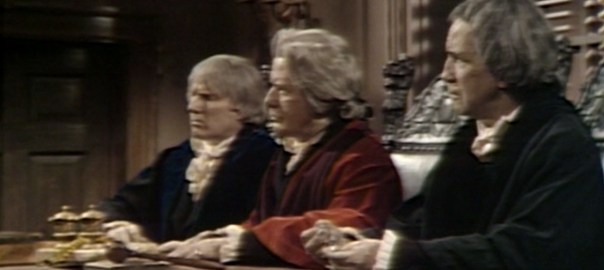
“Miss Winters, it was Abigail Collins who first recognized you as being a witch, wasn’t it?”
“Gentlemen, gentlemen,” says our learned colleague in the red robe, “we have had quite enough bickering between the two of you.”
You see? It’s not just me. Today’s episode has been on for less two minutes, and already everyone seems weary and put-upon. This witchcraft trial storyline is going to kill us all.

“I should like to give the defendant one last opportunity to denounce her master, and relinquish voluntarily the powers which link her to the Prince of Darkness.”
Hear ye, hear ye! The Collinsport Imaginary Witchcraft Court is now in session, Judge Hanley and his two unnamed and non-speaking associates presiding.
Yes, it’s finally time for the trial of Victoria Winters, girl governess, who’s been in prison for the last five weeks, charged with wearing funny clothes, knowing people’s names, owning a book, and running out of the house when a guy outside was yelling something about fire. That’s a pretty chilling rap sheet.
But this is the United States of America, or however much of it there was in 1795, and an accused person has the right to a speedy trial before a jury of her peers.
Unfortunately, Vicki comes from the 1960s, which means that her peers won’t even be born for another 150 years. That would hardly be a speedy trial, so let’s just chuck her in a courtroom and hope for the best.

“I can see you know nothing about the power of witchcraft.”
The notorious Salem Witch Trials were a series of arrests, hearings and executions that took place from March to October 1692. Twenty people were executed, and more than a hundred people were held in prison for almost a year.
The story is often used as an example of the devastating power of superstition and the suggestibility of the mob, but more than anything, it’s actually the story of a pre-Revolution American colony trying to figure out how justice works.
This was more than seventy years before the Declaration of Independence, when the colonies joined together to form a more perfect union. At the time, the Massachusetts Bay Colony was a Puritan settlement. There was no real distinction between civil law and religious law; the judges and magistrates mostly operated according to guidelines agreed upon by the senior ministers in Boston.
The accused witches didn’t have lawyers, or any representation. The charges against them were almost entirely imaginary, based on the “spectral evidence” of the possessed girls who screamed that they saw the witches’ shapes stabbing at them, and allowing invisible birds to suckle from the blood of their fingers. There were a lot of confessions, especially in the later months of the trials, but the confessed “witches” were mostly just answering yes to the magistrates’ leading questions.
And the hearings were just three-ring circus nightmares, day after day. While the defendant stood in the dock, the growing chorus of “afflicted girls” screamed and rolled on the floor, sometimes running up to the magistrates holding out their arms to show tooth marks where the defendant’s spectre had just bitten them.
The defendant would look at the girls, and the girls would fall down on the floor. The defendant would look away, and they’d get up again. That interaction on its own was enough to put somebody in chains for months.
During Martha Corey’s trial, one of the accusers threw her muff at the defendant. When that fell short, she took off her shoe and threw it, nailing Goodwife Corey in the head. The trial just continued after that, like that was normal trial procedure. Martha Corey was convicted, and executed. That’s how witch trial justice worked.
 Dark Shadows Every Day