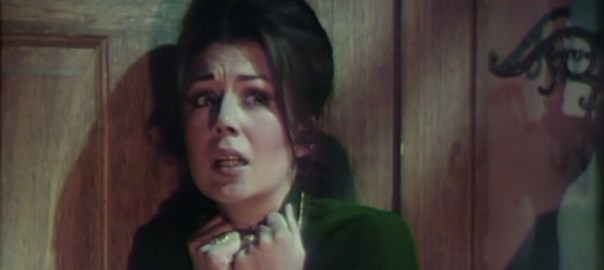
“I don’t want to know who you are!”
Did you ever have one of those days when nothing goes right? Well, this isn’t even one of those. Those are funny.
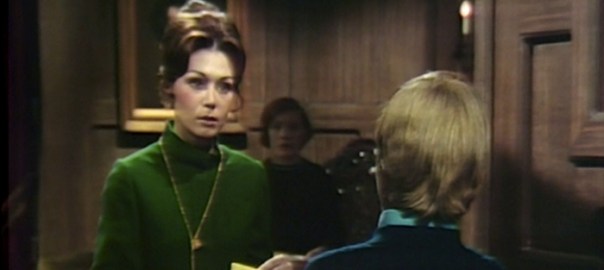
“I am concerned with the safety of other people, not what’s right.”
Michael is staring at Maggie Evans.
Maggie is a pretty young woman who used to be a waitress, and now works at Collinwood as David’s private tutor. Michael is a seven-week-old baby monster who came out of a time travelling box, and will someday cleanse the Earth of its human population. Everybody has to be something, I suppose.
Michael’s come over to the house today, unannounced and uninvited, because he wants to play with David and be insolent to grown-ups. Maggie was in the middle of a lesson with David, but now Michael’s here, and she’s not sure what to do.
The problem is that Michael is such an odd little boy. He says things that sound polite — “You wouldn’t do that, would you, Miss Evans?” he says — but he keeps his eyes locked on hers, unblinking, in a way that people generally don’t, unless they’re planning to murder you.
Maggie finally decides that it’s okay — she’ll grade David’s paper, and the boys can play in the drawing room. But as she’s gathering up the papers, she feels Michael’s eyes, still following her. She turns, and sees that he hasn’t moved; he’s just standing there at the door, staring her down.
She tries to collect herself, and says, “Michael, is something wrong?”
He keeps sizing her up. “What could be wrong, Miss Evans?” he asks, with a faint smile.
“You keep staring at me.”
Anxious to break the tension, David cries, “I’ve got it! We can play Wall Street. Do you like Wall Street, Michael?”
“It doesn’t matter what game we play, David,” the boy sneers. “You know that.”
So, yeah, of course they’re going to play Wall Street. This kid is the living embodiment of the Big Short.
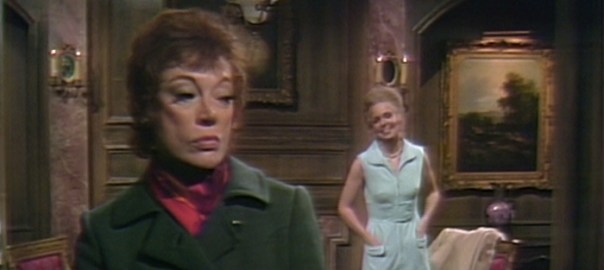
“We became friends in the past. Please, let us be friends now.”
Mrs. Rumson arrives at her palatial beach mansion on Little Windward Island, and greets her husband of six months, the handsome publishing magnate. She’s found peace at last, after so many years of struggles and schemes. She’s going to go straight, she said, and everyone laughed. But she’s on the level, this time. The dead past will bury its dead.
But nothing ever stays dead, not on this show. At least, not with Dr. Julia Hoffman around.
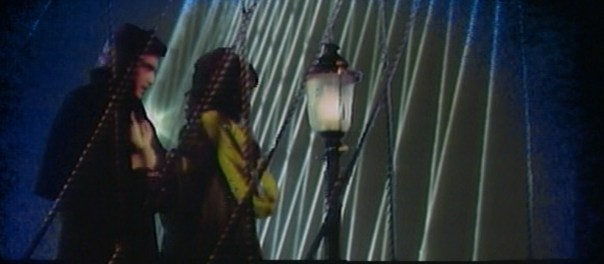
“If we can find more realities like that, maybe we can get him out of the mist.”
Okay, so do you remember how pretty much all of last year I was saying that the writers didn’t have a big master plan that connected Quentin’s haunting with Chris’ werewolf story, and that they had no idea that they were going to use Charles Delaware Tate’s magic portrait skills to cure Quentin and bring him to 1969 to reunite with his long-lost great-grandson? And everyone was like, no, they planned that all out, they knew the whole thing, like, totally in advance. And I was like, no, they’re just making it up as they go along.
Well, here we are, in Tate’s big dark mansion, with the culmination of this master narrative — Quentin, werewolf, Tate, portrait. So what’s the big payoff?
Nothing! Because they didn’t actually have a plan.
So everybody else was wrong and I was right, and that’s why I am the god emperor of understanding how Dark Shadows works.

“Barnabas never ceases to be exciting.”
My husband opens the doors to the drawing room, and finds me deep in thought, puzzling over an old book. I’m reading carefully, and transcribing some of the more difficult passages.
As he makes his way to the drinks cabinet, he asks, “Is that for the blog?” I tell him it is, and I show him the cover. He asks why I’m writing about this now, and I say that the book just came out.
“But that looks old,” he says.
“Yeah, it just came out.”
“What are you talking about?”
“I’m in January 1970. This was published in December 1969.”
“Oh, I see,” he says. “You were meanwhiling.” This is why our marriage works.

“That’s right, I’m a werewolf, and that’s why you’re gonna start painting right now.”
Here we are, in another haunted mansion, and sitting at the front desk is an audio-animatronic Charles Delaware Tate. He speaks, he turns his head, and his chest moves up and down like he’s breathing; I’d estimate this action figure has maybe six points of articulation. But it can’t be the real Chuck D, because he should be seventy-two years older than this.
Quentin and Chris are visiting this weird wax museum because they’re hoping that Tate can paint a picture for them. But Tate laughs at them, just laughs and laughs, until Quentin picks up a vase of flowers and hits him square in the chest with it.
And that’s how Charles Delaware Tate dies laughing, the target of a floral drone strike. He falls face first onto the desk, and then his head pops off and rolls across the floor.
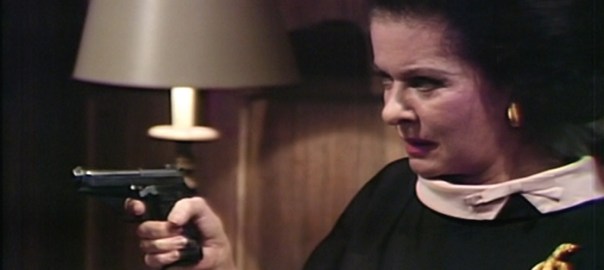
“Something kept you from disobeying the book!”
So we’re killing Julia again, apparently, that’s still a thing that people on Dark Shadows say they’re going to do.
David and Elizabeth are going over their secret evil world domination plans, and they’re doing it in a hallway, for some reason. “Barnabas asked me to remind you,” David says, “that Julia Hoffman is your responsibility.” David is thirteen years old.
She tenses up. David asks, “What are you going to do about her?” and Liz takes a moment to think. Then she says, “KILL her!”
That’s the right answer, so she gets a big closeup and a dramatic sting, followed by the opening titles. That’s how you know that your staff meeting is a success.
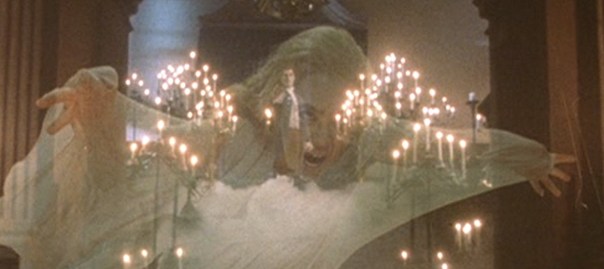
“It was some kind of mumbo-jumbo!”
Meanwhile, it’s 1790, and governess Victoria Winters is trapped by time, stuck two centuries early with no ride home. She’s been locked up and accused of terrible things, and now she’s on trial for her life, represented by pop-eyed barrister Peter Bradford. Opposing counsel is the Reverend Trask, who’s assisted by reckless spinster Abigail Collins and his own eyebrows, not necessarily in that order. And the Countess Natalie DuPres is terribly worried about her niece Josette, a young woman who seems entirely unable to date anyone with more than a couple of days to live.
Oh, and Barnabas — d’you remember Barnabas? He used to be the main character on this television show — Barnabas is in a box, all by himself.
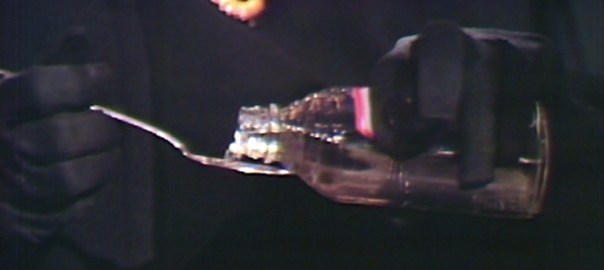
“Is there anything in that milk?”
Sssh! Someone might hear! They’re after me! I’ve got to get away! Anywhere, away from here!
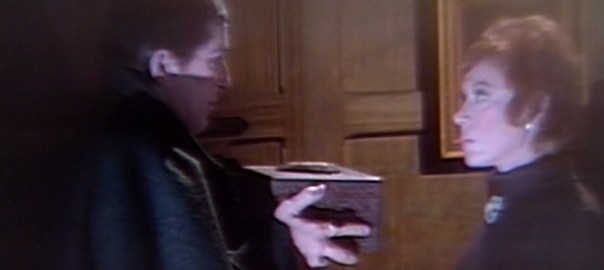
“There are two things you’ve got to know. One is that I think he’s slightly mad.”
And we’re back! Yesterday’s Dark Shadows episode was recorded three weeks out of sequence, and slotted into place in order to signal an upcoming storyline course correction. This is a situation that does not occur in nature.
They had this idea, you see, where Barnabas Collins, the main character of this daytime creeps machine, would suddenly swear allegiance to some kind of interplanetary invasion force of shapeless pre-prehistoric essence, which is plotting to replace the human race with a population of quick-growing four-headed snake monsters. Or something. It’s hard to explain, which I guess is the problem.
The kids who hang around outside the studio door after school said that a) they didn’t understand the storyline, and b) they wouldn’t like it even if they did, so the producers said I know what let’s do, let’s make a special episode where we explain that Barnabas doesn’t really want to be doing all the things that he’s been doing lately, and stick it in three weeks early, to signal to the audience that we’re aware that our story doesn’t make any sense, and we’ll change it as soon as we can. And then they went ahead and did it.
What I’m saying is, that’s a really not-normal way to run a television show, especially a high-rated show like Dark Shadows. Yes, the ratings have been slipping a bit since they started the Leviathan story, but that’s coming down from an all-time ratings peak that they hit only two months ago. There’s still a lot of people watching this show.
So what just happened was that the main character of a television show went to sleep, had a dream where the show apologized for the current storyline, and then woke back up and continued on as usual. I can’t think of anything to compare that to. That’s an approach that begins and ends with Dark Shadows.
 Dark Shadows Every Day