Tag Archives: portraits

Episode 923: Probably Her

“If we can find more realities like that, maybe we can get him out of the mist.”

Okay, so do you remember how pretty much all of last year I was saying that the writers didn’t have a big master plan that connected Quentin’s haunting with Chris’ werewolf story, and that they had no idea that they were going to use Charles Delaware Tate’s magic portrait skills to cure Quentin and bring him to 1969 to reunite with his long-lost great-grandson? And everyone was like, no, they planned that all out, they knew the whole thing, like, totally in advance. And I was like, no, they’re just making it up as they go along.

Well, here we are, in Tate’s big dark mansion, with the culmination of this master narrative — Quentin, werewolf, Tate, portrait. So what’s the big payoff?

Nothing! Because they didn’t actually have a plan.

So everybody else was wrong and I was right, and that’s why I am the god emperor of understanding how Dark Shadows works.

Continue reading Episode 923: Probably Her

Episode 910: Epistemology of the Portrait

“Look, I’m really not someone who lived a hundred years ago.”

We’ve got it all wrong, of course. We usually do.

An understanding of virtually any aspect of modern Western culture must be not merely incomplete, but damaged in its central substance to the degree that it does not incorporate a critical analysis of the structured binary opposition between the signifiers “Quentin Collins” and “Grant Douglas”. The only way to properly understand these meanings is to deconstruct the assumptions and knowledge systems that produce the illusion of singular meaning.

Quentin Collins understands that. I understand it, too. The rest of you are just going to have to catch up.

Continue reading Episode 910: Epistemology of the Portrait

Episode 885: Not in Canvas Anymore

“I want you to do nothing. Promise me that, and I will not use the coffins.”

Now, from Josette’s point of view, it’s a weird decision either way, but it gets weirder the more that you think about it, which personally I was planning never to do. But let’s take a moment.

Kitty Soames — a living human woman, in the year 1897 — has discovered that she is the reincarnation of Josette DuPres, who toppled over a cliff in 1795. Reincarnation means that it’s the same spirit, reborn in a new body. Right? That’s what this story point has done to me; it’s made me question what reincarnation means.

So Kitty is Josette, in some kind of fictional necrobabble way. And listening to Josette’s music box put her into a kind of fugue state, where she remembered being Josette. I’m okay with that part.

But now Kitty is trying to suppress those memories, because she’s worried that the Josette persona will take over. So she goes to Josette’s room in the Old House, and argues with the portrait.

“I’ve got to go away to live my own life, and you can’t come with me!” she says. “You’ve got to let me be myself! I’ve got to forget Josette DuPres!” And then the portrait sasses her back, saying, “It is Kitty Soames you must forget!”

Now, obviously, if she’s really Josette, then who is she talking to, but it’s metaphor, it’s stagecraft, it’s a vampire soap opera and who even cares. And then there’s the floating.

Continue reading Episode 885: Not in Canvas Anymore

Episode 884: Widow’s Hell

“I don’t know, and you don’t know, none of us knows, and we probably never will know, and besides, I don’t care.”

It’s morning, and time jockey Barnabas Collins is standing in the ruins of the scene of the crime, sifting through the fragments of storyline left behind after a raging inferno. Combing through the ashes, he finds a few traces of the battle that took place here — a pocket watch, a pair of glasses, a length of heavy chain.

The glasses belong to Count Petofi, and the chain is Garth Blackwood’s — the two titans who clashed and burned here — but the pocket watch is new to me. Did Count Petofi have a pocket watch this whole time, and I never noticed? Well, I suppose he can retrieve it from the lost and found on his way out.

Continue reading Episode 884: Widow’s Hell

Episode 874: The Rape of Kitty Soames

“I mean, that makes a girl feel all creepy, having all that ‘ocus-pocus said over her!”

What do you think it feels like?

When you “switch off”, I mean. When you suddenly wake up and you’re wearing clothes that you don’t recognize, and you find out that you just had a fight that you don’t understand, with somebody that you’ve never met.

You haven’t been drinking; it wasn’t a blackout. You were just sitting in a room, and you heard a strange sound, and the next thing you know, it’s an hour later, you’re downstairs, and you’re screaming at an oil painting.

And what do you think it feels like, when somebody that you hardly know looks you right in the eye, and tries to convince you that you’re the intruder?

I don’t know about you, but if that happened to me? I’d probably punch that person in the face, and keep on punching until there’s nothing left to punch.

Continue reading Episode 874: The Rape of Kitty Soames

Episode 870: The Collapsing Cat

“Have I come back to tragedy and death again?”

We left off yesterday with Erwin Schrödinger and his magical cat, trapped in a thought experiment about quantum indeterminacy that threatens to destroy us all.

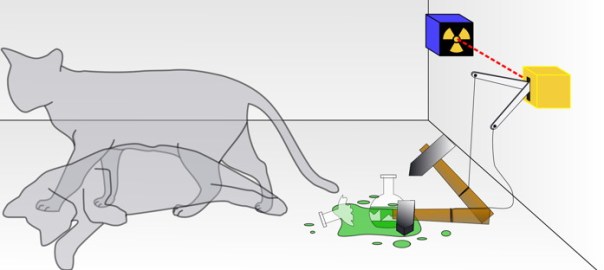
Here’s how it works: The theoretical cat is placed in a sealed chamber with a Geiger counter, a hammer, a flask of cyanide, and a small chunk of something radioactive, which may or may not decay over the course of an hour. Within that hour, there are two possibilities:

#1. The atom decays, which is detected by the Geiger counter, which trips a sensor that makes the hammer smash into the flask, releasing the cyanide and killing the cat.

#2. The atom doesn’t decay, which means no Geiger, no hammer, no cyanide. In that case, the cat is alive at the end of the hour, and it can go about its business.

Now, according to quantum mechanics, the atomic decay in the radioactive substance is in both states simultaneously — both decayed and not — until it’s observed, at which point it resolves into one state or the other. And if the cat’s life is determined by the unresolved atomic decay, then the cat is both alive and dead at the same time — until you open the box and look inside, which causes the wave function to collapse into either “alive cat” or “dead cat”. And then you feed the cat, or bury it, as appropriate.

But Schrödinger completely missed the third alternative, which is that the cat would look at all this equipment, and figure out what’s going on.

At that point, you have an undead cat, sitting alone in a steel box with a flask of cyanide, a hammer and an active source of plutonium, and nothing to do for the next fifty-five minutes but think about the future. Schrödinger has created a dangerous supernatural entity, and provided it with an arsenal.

You don’t resolve a situation like this by opening the box. Opening the box is the beginning of act two.

Continue reading Episode 870: The Collapsing Cat

Strange Paradise, Episode 1: Dry Ice Burns

“Mr. Desmond, please! Has the Devil taken your SOUL?”

Dreamed in darkness and filmed in Canada, the Shadow of Shadows was dragged from the earth. The creatures scratched at the well-worked soil, pulling what little they could from the oft-defiled graves. Look! A rag, and a bone, and a hank of hair. Isn’t it beautiful, they said. We have given it a name.

In the fall of 1969, a show called Strange Paradise shambled onto the air — a Canadian soap opera with supernatural themes, conceived at the height of Dark Shadows’ popularity. The daily show premiered in America in September, with the Canadian debut six weeks later.

In the US, Strange Paradise aired around 7pm on local stations owned by Metromedia and Kaiser Broadcasting, but not for long. A month after its debut, Metromedia pulled the low-rated show from New York and Los Angeles, and Kaiser stations moved it to the early afternoon.

In an attempt to save the show, the production company replaced the producer and writer after the ninth week of production. When they finished the first 13 week cycle, the show was extensively retooled, ditching most of the cast and moving the setting from the Caribbean island of Maljardin to the Desmond family’s ancestral home in North America. It didn’t work. They managed to scrape through another 26 weeks, and then gave up.

Strange Paradise enthusiasts talk about the show’s “three 13-week arcs,” but that’s just a fancy way of saying that it was cancelled after ten months. In Dark Shadows years, that’s just at the moment that they would have hired Jonathan Frid, and saved the show.

As a Dark Shadows fan, I’ve seen Strange Paradise mentioned in books occasionally, and I always thought it was a DS clone created by ex-Shadows staffers. That’s not actually how it happened. The creators were Jerry Layton, a producer who’d mostly done crime dramas before moving into romance, and Ian Martin, a soap writer who’d worked on Search for Tomorrow, Young Doctor Malone and The Nurses. The pair had worked together on the successful NBC soap The Doctors, before being hired for Strange Paradise.

The Dark Shadows people were brought in later, following the Metromedia and Kaiser disaster. Producer Robert Costello was brought in to replace Layton at week 9, and Ron Sproat joined the writing team for the second 13-week cycle, with occasional scripts by Joe Caldwell.

So this is a weird footnote in the history of Dark Shadows, and since the show started during this period, I’m going to watch the first week with you, to see what people do when they think they’re making Dark Shadows. All of the episodes have been posted on YouTube, so you can watch along, if you like.

I figure it’ll be fun — we’ll take a week’s vacation from Dark Shadows, and see what it’s like on the other side. What could possibly go wrong?

Continue reading Strange Paradise, Episode 1: Dry Ice Burns

Episode 834: The What’s-Thatters

“Death runs faster than any man.”

A memo from young Icarus to his father, re: altitude. What are you talking about, Dad? These wings that you made from feathers and wax are working great. Why do you say that I’m flying too high? You’re supposed to fly as high as you can, that’s the whole point of flying!

And so, as Icarus sinks slowly in the west and learns some valuable lessons about swimming, let’s turn to Dark Shadows creator Dan Curtis. In defiance of good taste and common sense, Dan has turned his poky little soap opera into a five-alarm spookshow spectacular, delighting the teenagers and housewives of America with larger-than-life characters, hair-raising plot twists and inventive special effects. The ratings are still climbing, which makes Dan wonder: What can I do for an encore?

Today, we see Dan’s first answer to that question — Dead of Night, a primetime pilot for ABC that tried to adapt the Dark Shadows formula to an hour-long nighttime drama. Dan produced this pilot in late 1968, with several members of his Dark Shadows family — director Lela Swift, writer Sam Hall, composer Bob Cobert, and actors Thayer David and Louis Edmonds.

ABC finally broadcast the hour-long pilot in late August 1969, because they’d already paid for it and you might as well. While he’s been waiting for it to air, Dan’s scaled his ambitions up even further — he’s currently pursuing a deal with MGM, to make a Dark Shadows film. So before that kicks off, it’s useful for us to take a look at this pilot episode, “A Darkness at Blaisedon”, and see Dan’s first attempt to bring Dark Shadows to a wider audience.

Constructed haphazardly out of feathers and wax, Dead of Night introduces a trio of new characters — psychic investigator Jonathan Fletcher, his live-in chum Sajeed Rau, and the beautiful young heiress Angela Martin — and throws them onto a haunted house set, to see how far they can fly. Icarus, you are cleared for takeoff.

Continue reading Episode 834: The What’s-Thatters

Episode 833: 3D Printing – The Early Years

“I’m accusing you of painting a portrait of a wolf!”

“Things don’t always have to have explanations,” says Mr. Tate, and that might as well be Dark Shadows’ mission statement. “You don’t have to know about everything in the universe. Things just happen, it could be one of those things that –”

And then he’s cut off, by someone threatening to kill him. That happens a lot in 1969, when people start babbling about the universe.

Continue reading Episode 833: 3D Printing – The Early Years

Episode 807: Dickens Without Poor People

“Well, you know how he gets when he possesses someone.”

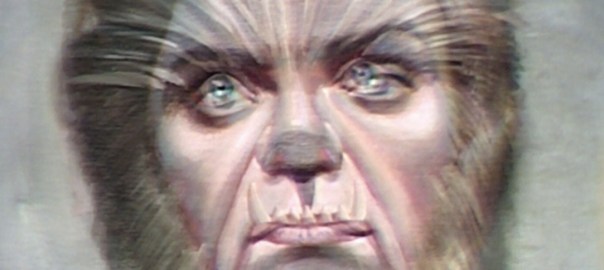
Behold the educated viewer, watching an episode of Dark Shadows. Charity Trask is looking at the unfinished portrait of Quentin Collins, on the night of the full moon. To her surprise, she sees the portrait change before her eyes, the painted face transforming into the image of a werewolf.

“Ah,” one nods appreciatively, “an allusion to The Picture of Dorian Gray.” One says this to oneself, because nobody else can stand to be around one while the television is on.

Continue reading Episode 807: Dickens Without Poor People