Category Archives: February 1969

Episode 685: A Fish Called Ezra

“Don’t get mad at me, Quentin. I just don’t like when you do terrible things.”

INT. COLLINWOOD — NIGHT.

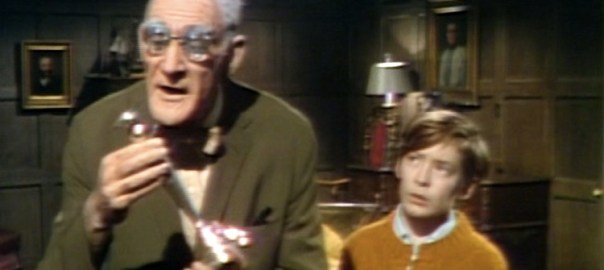
We hear a young boy’s voice, as we pan across the foyer. “Are you sure that’s all you want me to do?” he wheedles. “Are you telling the truth?”

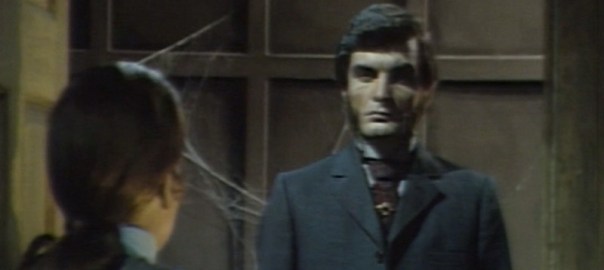
We move through the open drawing room doors to find young David, communing with an impossible shred of hatred and regret which has clawed its way out of the unseen, a forgotten trespasser bespoiling the surface of the earth. It’s just standing there, in the drawing room. It’s the damnedest thing.

Continue reading Episode 685: A Fish Called Ezra

Episode 684: Barnabas Collins and the Mysterious Ghost

“Lots of things happen in this house that no one can understand.”

It always starts with a box.

You take your fears and your crimes and your regrets, and you bury them deep in the earth, and you tell yourself that no one will ever know. Nobody has a key, and nobody knows where you buried it, and nobody knows that it even exists. The mystery box is hidden forever.

But you know that it’s only a matter of time. Boxes open. That’s pretty much the whole point of boxes.

Continue reading Episode 684: Barnabas Collins and the Mysterious Ghost

Episode 683: The Very Last Ron Sproat Episode

“I want you to tell me what you know of a tall blonde woman in a long, flowing white dress.”

On February 5th, 1969, ABC aired what is generally considered to be the worst half-hour of network television, the first episode of a sketch comedy show called Turn-On. The show managed to be both offensive and incomprehensible, which is quite a trick, and on at least one station, it was cancelled during the first episode.

The conceit of Turn-On was that it was produced by a computer, which spliced together lots of little shards of not-funny. The show didn’t have any sets; it was just filmed against a stark white background. An odd-looking character would appear and do something strange, and then they’d cut to something else.

Almost all of the jokes were about sex, and sometimes they just flashed the word SEX! on the screen, in various colors. They also flashed captions with jokey references to sex and gay people, including “God Save the Queens,” “Free Oscar Wilde,” “Make Love Not Wine,” and “The Amsterdam Levee Is a Dike.” Sometimes the screen would be divided into four comic-strip panels, and the sketch would be performed in discrete chunks, one in each panel. The ending credits were split up into pieces and aired throughout the show.

WEWS, an ABC affiliate in Cleveland, took the show off the air during the first commercial break, and just didn’t show the rest of the episode. I don’t know what they filled the extra twenty minutes with, but it was better than Turn-On, so it could have been literally anything.

And on the same day — February 5th, 1969 — ABC also aired the last episode of Dark Shadows written by Ron Sproat. ABC was just having a bad day overall.

Continue reading Episode 683: The Very Last Ron Sproat Episode

Episode 682: The Four Maggies

“We know you were destroyed by some evil force! Now is your chance to destroy it!”

It’s a situation that only happens in long-running serialized narrative. The main character has run away, never to return, and she didn’t even bother to make up a decent excuse. “I’m going to go and live with my husband’s past-life doppleganger,” Vicki said. “If you need to reach me, I’ll be in the 18th century.”

So what can you do? You hire a new governess, and you move on with your make-believe life. The Collins family has lost their lost princess, and to take her place, they’ve found Maggie Evans, a waitress with no experience in education, and a gaping hole in her LinkedIn profile that she can’t explain.

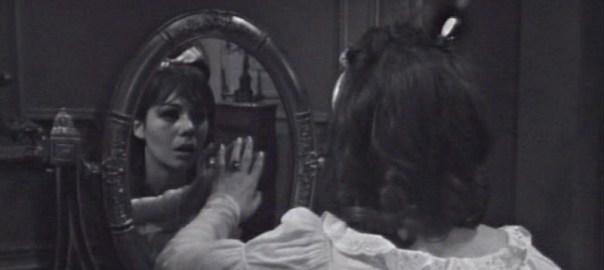
It hasn’t been an easy transition for Maggie, because the process of Vickification involves stripping away all ties to her old life. In fact, on the night that she was offered the governess job, both her fiancee and her house were torn to pieces by a wild animal. I don’t know how you arrange for an onboarding process like that, but it definitely made the point. Her father and her fiancee are gone, her home is destroyed, her memory is wiped clean, and she has become Vicki.

But that interpretation assumes that there’s only one Maggie, and one Vicki. It’s more complicated than that. There are actually four Maggies, and most of them are Vicki.

Continue reading Episode 682: The Four Maggies

Episode 681: Could He Talk?

“You think he went upstairs, knowing a strange man was lurking there, and told him to frighten you?”

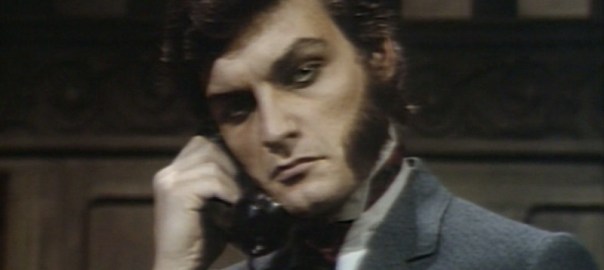
In the first week of February 1969, David Selby was on daytime television four days out of five, with dark eye makeup and glued-on muttonchops, making faces at the camera. But on the inside, something even more mysterious was taking place, as Selby described in his 2010 memoir, My Shadowed Past:

Perhaps the few months of silence that Quentin endured gave me a chance to get acquainted with him. The fun an actor gets to have when creating a character. While in Illinois I discovered an Edgar Lee Masters poem, Silence. I rediscovered it when conjuring Quentin. Silence was my bridge to Quentin.

And there is the silence of the dead.
If we who are in life cannot speak
Of profound experiences,
Why do you marvel that the dead
Do not tell you of death?
Their silence shall be interpreted
As we approach them.

So, I cautiously approached Quentin — trying to learn what he was, who he was, what he wanted, what he desired, what he was seeking, what he was curious about, angry about. He could walk into a situation and know who was his enemy, who was a fool. He could be much smarter, much more charming, more ruthless than I ever could be. He liked brandy. He could be self-deceptive, vain (check the pompadour), foolish, hyper, lonely, ridiculous, macho (where was Gloria Steinem when they needed her), and he was inflicted with a false confidence. But first, would he, could he talk?

Continue reading Episode 681: Could He Talk?